|
| Completed forms ready to go |
With the band saw out of commission due to a broken blade, I was stopped in my tracks from cutting and shaping the forms along the paper pattern. I resorted to using my Mitabo jigsaw, which had served me well during the fitout of Malua; however, that also threw in the towel when the plunger tube broke from metal fatigue.
I searched the internet for a band saw blade and found two Canberra shops – one of which I had dealt with before to replace the said blade. Driving around the industrial area to see if I could get a replacement immediately proved fruitless. Both hits were closed down, and the standard tool shops with a large range of hand and workshop tools just looked at me blankly with no choice or suggestions. So I "jumped on the internet" and ordered two from China and one from a Brisbane saw and knife sharpening outlet. The latter was about twice the price, which did not include express postage. Now 10 days later, the Brisbane mob don't know when my new blade will be ready, though they assure me it is on their list to attend to, while the Chinese supplier informed me it is with the local Australian carrier and will be delivered tomorrow. Now that is service and why Australian manufacturing cannot compete.
During my search for a replacement jigsaw, I found a Makita very similar to my broken one and ordered that to also be express delivered from Sydney. It took more than a week to arrive, but it turned out to be a great replacement.
After ordering the replacements, I thought it time to take a break and visit Bermagui to continue my consulting work writing operational procedures for the commercial fishing vessels. It was a long drive, but when I returned, I was able to focus on the winter project of fitting the forms to the strongback.
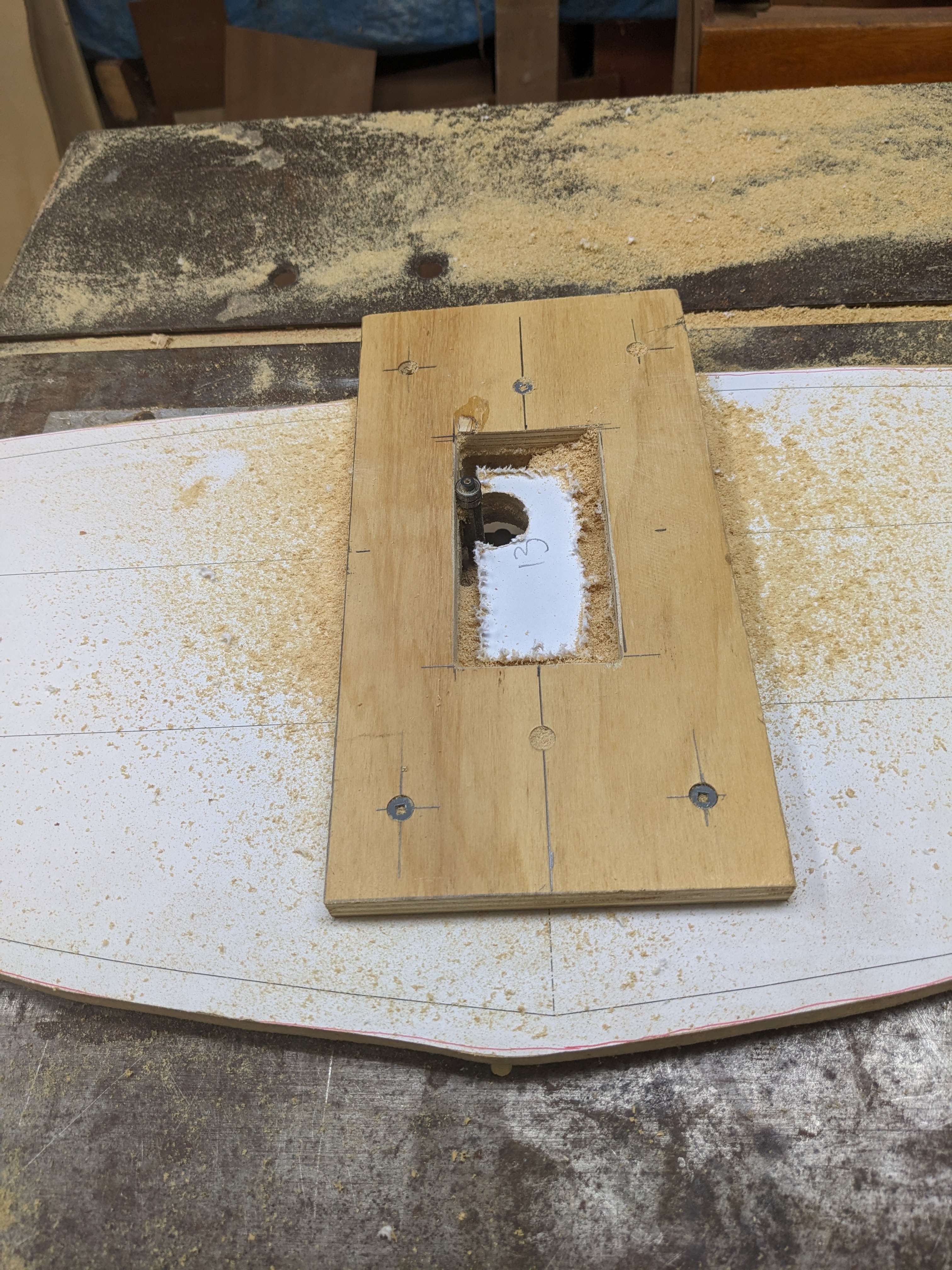
Back in the workshop, without either a bandsaw or a jigsaw, I set about drilling holes in the forms to accommodate clamps to be used to hold the strips to the forms. The drill press came in handy. All done. Wait for jigsaw.
 |
| Drill press for holes |
The new jigsaw turned out to have the latest features of speed control and tilting cut. I tested the new saw by cutting out the clamp shapes and found it to work very well indeed.
 |
| Cutting clamp holes |
I used the tilting feature of the jigsaw to great effect. As each form gets narrower towards the bow and stern, the ¾-inch wide form narrows as well. The paper pattern indicates the exact outline where the strips are to be attached to the form, but one has to make adjustments for the width of the form. One has to cut the form along the paper but angle the wood behind that to follow the lines of the kayak strips. These lines change radically near the pointy ends but are gradual at the middle. They are also not a consistent angle as one moves around the form from the keel to the top of the deck.
To address the issue, one cuts the form slightly larger and then uses a sander to angle the form to fit the line. The recommended method is to use a vertically mounted belt sander, but I tried that and found it difficult to adjust the angle, so I resorted to my trusty rotating sanding disk attached to a slow but powerful electric motor. I was able to adjust the angle as I moved around the form, and this smoothed them to suit the strips.
 |
| Smoothing form on rotary sander |
Then an idea came to me to use my new jigsaw with the adjustable angle cut. It worked well for those areas that had a consistent angle, but I soon adjusted and returned to the sanding disk to make the finishing touches.

The forms were fitted to the strongback, and everything looks ready to go. Now to sort through my timber stack and select suitable pieces to cut into strips. I will need 300 19mm strips, of which about 60 will be full length – 4.72m long. That is only 0.076 cubic meters of timber.
 |
| Bow forms |
 |
| Stern forms |